JetPallet Try it free

Use case · Cargo space

Plan pallets in trucks and containers

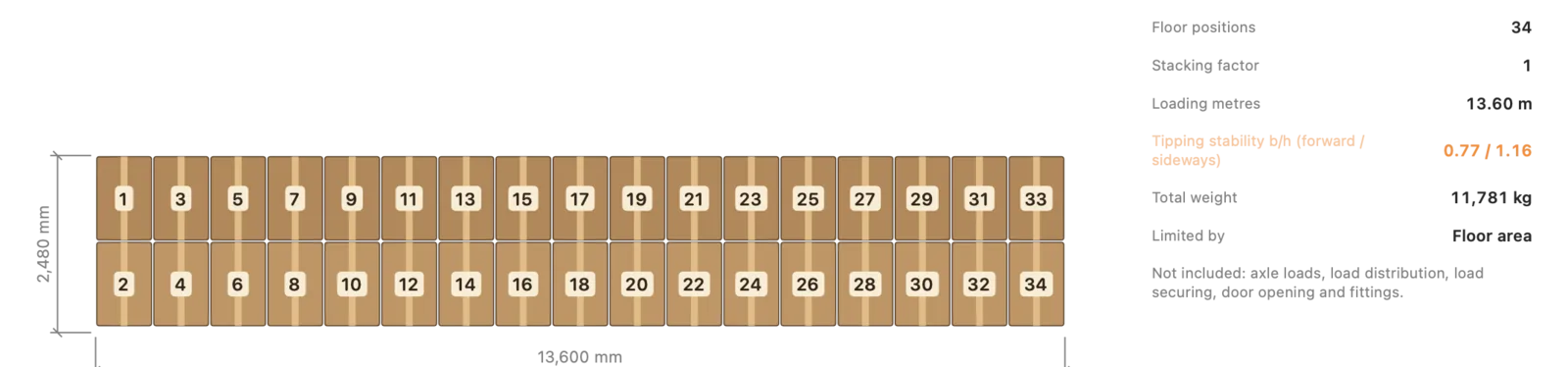
How many pallets fit in a truck or container depends on internal length, width, height and payload – and on whether the pallets go lengthways or crossways and whether they can be stacked. Euro pallets placed crossways take 800 mm of length per row; with 13.6 m of internal length that is 17 rows of 2, or 34 floor positions, provided the internal width is at least 2,400 mm. JetPallet works this out with your actual pallet, its weight and your cargo space.

13.6 m2480 mm
13.6 m semi-trailer: 34 EUR pallets crosswise (2 × 17), 13.6 loading metres. Illustration, calculated with this page’s web calculator.

Workflow

How it works in JetPallet.

  1. 1

    Plan the pallet

    The starting point is the calculated pallet with its actual height including the pallet itself and its gross weight. If you then change the carton or pallet, JetPallet marks dependent results such as vehicle allocation, axle loads and arrangement as out of date; they are recalculated at the press of a button.

  2. 2

    Choose a cargo space

    Pick a cargo space: “Plan cargo space” offers 13.6 m semi-trailer and mega trailer, a 7.5 t truck (7.2 m box body), 20′, 40′ and 40′ high-cube containers and the US 53′ trailer. For mixed loads there is the cargo-space library, including reefer, open-top and flat-rack containers. Or set up your own with internal dimensions and payload.

  3. 3

    Calculate positions and loading metres

    “Plan cargo space” places the pallets on the floor with the same verified pattern calculation, lengthways or crossways, stacked if the internal height allows, and shows pallets, cartons, total weight, loading metres and the limiting factor.

  4. 4

    Compare vehicles

    The cheapest-vehicle option searches built-in and custom cargo spaces for a low-cost feasible combination based on your costs, and sets it against the solution with the fewest vehicles. For small cases the result is exact; otherwise it is labelled as an approximation, meaning the minimum is not proven.

  5. 5

    Output the load plan

    Export the vehicle load plan as a PDF with loading steps and a driver sheet, as a shareable HTML 3D plan, or as CSV/JSON.

Floor positions are only half the answer

Dividing up the floor is quick. It gets harder once several limits apply at the same time:

  • Payload: heavy pallets reach the permitted weight before the floor is full. Then mass decides, not the number of positions.
  • Height: whether two pallets fit on top of each other depends on the internal height and the actual load height – and on whether the lower pallet may carry the load above it.
  • Loading metres: many hauliers charge by the length of floor used. If you book part loads, you need that figure before you ask for a quote.
  • Vehicle choice: one semi-trailer, two swap bodies or a container? The cheapest option depends on your own costs.

In a spreadsheet, every change to the carton means recalculating by hand. In JetPallet, carton, pallet and vehicle share one model.

What you end up with

  • Floor positions, pallets and cartons per vehicle
  • Loading metres, total weight and limiting factor
  • Comparison of cheapest vehicle and fewest vehicles
  • Vehicle load plan as PDF with driver sheet
  • Shareable HTML 3D plan and mobile loading view
  • Load layout as CSV or JSON

In detail

In detail

01

Cargo space library with sources

21 built-in, sourced profiles – 11 planning profiles (20′/40′/40′ HC/45′ HC containers, curtainsider, box, mega and reefer trailers, swap bodies) plus 10 reefer, open-top and flat-rack containers – follow published manufacturer data, and the sources are documented. Reefer containers include their load line. The profiles are read-only; for anything different, duplicate one as your own profile.
Cargo space library with sources
Actual JetPallet interface.

02

Custom cargo spaces

Set up your own vehicles with internal dimensions and payload, edit them and share them with colleagues as JSON. On import you decide whether to keep, replace or add a profile as a copy.

03

Cheapest vehicle

You enter costs per trip and per kilometre for each cargo space. JetPallet looks for a low-cost feasible combination, including mixes of vehicle types, and marks options on the Pareto front. The search is exact only for small cases; larger results are labelled as an approximation. Add your own CO₂e factor per vehicle kilometre and a comparison figure appears as well.

Cheapest vehicle
Actual JetPallet interface.

04

Mixed loads, exclusion areas and stops

For mixed shipments, JetPallet plans actual loaded pallets of different heights and masses into the vehicle. Up to 50 exclusion areas keep space clear, temperature zones assign pallets to suitable areas, and delivery stops set the loading sequence. More under mixed pallets and multi-stop.

05

Plan backwards: from product to vehicle

Reverse planning links outer carton, pallet and cargo space: you set the product and quantity and see unit counts, remaining quantities and any breached limits at every stage.

06

Load line, double deck, compartments, stacked pallets

  • Load line: in reefer containers the maximum stowage height limits the usable height; the check reports cargo above the load line.
  • Double deck: 1 to 3 decks with floor height, clear height and optional payload per deck – for a single vehicle only; axle-load balancing is locked in this mode.
  • Multi-compartment: 1 to 5 compartments from the front wall; compartments become temperature zones, bulkheads become exclusion areas of their thickness.
  • Stack pallets: stack identical loaded pallets within total height, total mass and permitted top load. You set the top load from an external source – this is not a load-bearing verification.

Questions

Frequently asked questions.

How many Euro pallets fit in a semi-trailer?

With 13.6 m of internal length and at least 2.4 m of internal width, 17 crossways rows of 2 fit, so 34 Euro pallets on the floor. Whether all of them can be loaded depends on payload and pallet weight; stacking allows more if height and top load permit.

What are loading metres?

Loading metres describe the length of floor used, measured from the front wall. JetPallet shows them for the planned layout. How a haulier charges for loading metres is up to the haulier.

Can I add my own vehicles?

Yes. Custom cargo spaces with internal dimensions and payload are stored locally, can be shared as JSON and are available in cargo space planning, reverse planning and the cheapest-vehicle option.

How many cargo-space profiles are built in?

21 sourced profiles: 11 planning profiles for containers and trailers plus 10 reefer, open-top and flat-rack containers, each based on published manufacturer data with its source. “Plan cargo space” adds seven vehicles, including a 7.5 t truck and a US 53′ trailer, and you can create as many custom cargo spaces as you need.

Plan your next truck

Test JetPallet free for 14 days with every feature, then USD 99 a year. Runs locally on macOS 15 or later, no account needed.

Try it free

Free for 14 days · then USD 99/year

Try it free14 days freeUSD 99/year