JetPallet Try it free

Use case · Strength

Box compression strength: can the bottom carton carry the layers above?

Box compression strength (BCT, from the Box Compression Test) is the vertical load an empty carton withstands before it buckles. Without a lab, you can estimate it with the McKee formula from edge crush test (ECT), board thickness and carton perimeter. JetPallet works out this estimate for your carton, divides it by your safety factor and compares the result with the load resting on the bottom carton of the planned pallet.

Column and interlocked stacking

1200 mm800 mm300 mm300 mm300 mm300 mm400 mm400 mm
Layer plan: carton 400 × 300 mm on 1200 × 800 mm – 8 per layer. Drawn by this page’s web calculator.

Workflow

How it works in JetPallet.

  1. 1

    Plan the pallet

    Enter carton, weight and pallet. JetPallet calculates the pattern and the number of layers. The load on the bottom carton follows from the full layers above it.

  2. 2

    Enter the board data

    Open “Compression strength …” and enter ECT and board thickness – or pick flute type and grade from the small catalogue. If you have a measured BCT, enter it; it then takes precedence over the estimate.

  3. 3

    Set the safety factor

    The overall safety factor covers storage time, humidity, stacking pattern and overhang. You set it yourself; JetPallet does not supply a default.

  4. 4

    Read the result

    The verdict is “permitted” or “too high”, each with the headroom as a percentage. The headroom also appears in the inspector next to the pallet and updates as soon as you change layers, weight or carton size.

More layers mean more cartons – and more load

A taller pallet saves floor space and trips. But every extra layer presses down on the cartons beneath it. Whether the bottom carton survives weeks in storage, humidity and the chosen stacking pattern often only becomes clear when it gives way.

Lab BCT values are not always available, especially for new carton sizes. A transparent estimate helps you sort options early: which height is plausible, where there is headroom, and where you should ask for a stronger board grade or a proper measurement.

What you end up with

  • Estimated BCT (McKee) or measured BCT
  • Permissible load after the safety factor
  • Static load on the bottom carton
  • Status permitted, too high or incomplete, with headroom as a percentage
  • Min/typical/max range from the board catalogue

In detail

In detail

01

A McKee estimate you can follow

JetPallet uses the simplified McKee formula: BCT = 5.874 · ECT · √(t · Z), with ECT in kN/m and board thickness t and carton perimeter Z in mm. Example: an ECT of 7 kN/m, 4 mm board and a 1,200 mm perimeter (roughly a carton with a 400 × 200 mm footprint) give about 2,849 N.
02

Compared with the actual stack load

The permissible load is the BCT divided by your safety factor. It is compared with the static load of all full layers above the bottom carton – taken from the planned pallet, not from a rule of thumb. If inputs are missing, the result reads “incomplete”, never “permitted”.

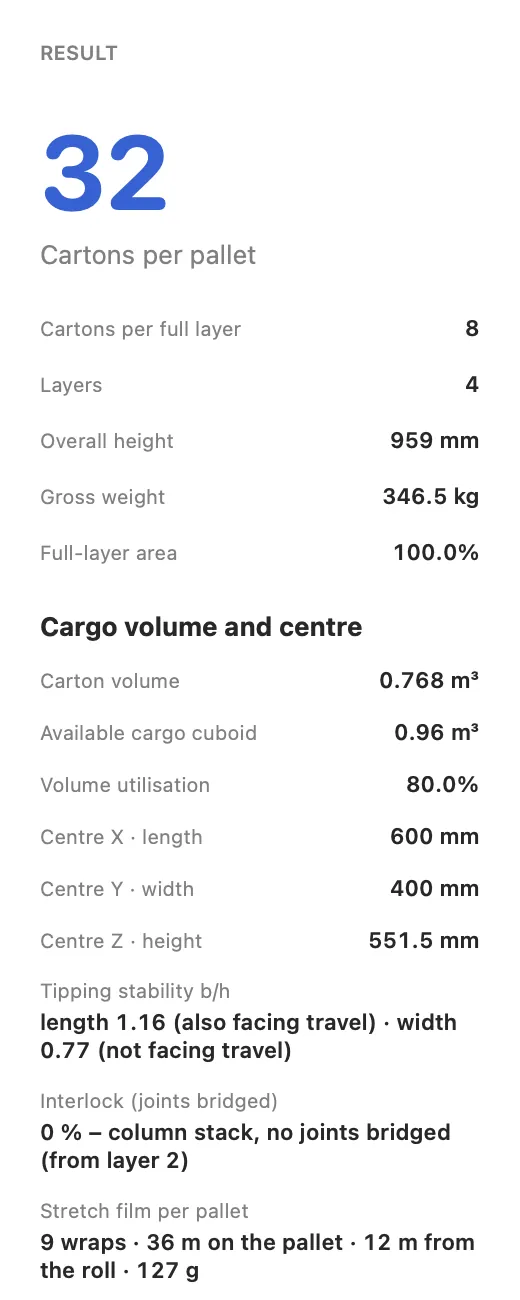
Compared with the actual stack load
Actual JetPallet interface.

03

Board catalogue with a range

For single-wall (B, C, E) and double-wall board (BC, EB), the catalogue holds the minimum ECT per grade and thickness ranges from documented sources. Picking an entry fills in the minimum ECT and the lower thickness, so the check errs on the safe side. JetPallet also shows a range from minimum, typical and maximum thickness. Supplier data and measured values take precedence.

Questions

Frequently asked questions.

What is the BCT of a box?

BCT stands for Box Compression Test: the vertical load at which an empty carton buckles in a test press. For pallet planning it is divided by a safety factor, because storage time, humidity and stacking pattern reduce the load a carton can carry.

How accurate is the McKee formula?

It is an approximation based on edge crush, board thickness and carton perimeter. It is useful for a first comparison of options but does not replace a measurement, which is why a measured BCT takes precedence in JetPallet.

Which safety factor should I use?

That depends on storage time, climate, stacking pattern and overhang, and is best agreed with your packaging supplier. JetPallet deliberately does not set a default.

Check the headroom before the pallet grows

Try JetPallet free for 14 days with every feature, then USD 99 a year. Requires macOS 15 or later.

Try it free

Free for 14 days · then USD 99/year

Try it free14 days freeUSD 99/year